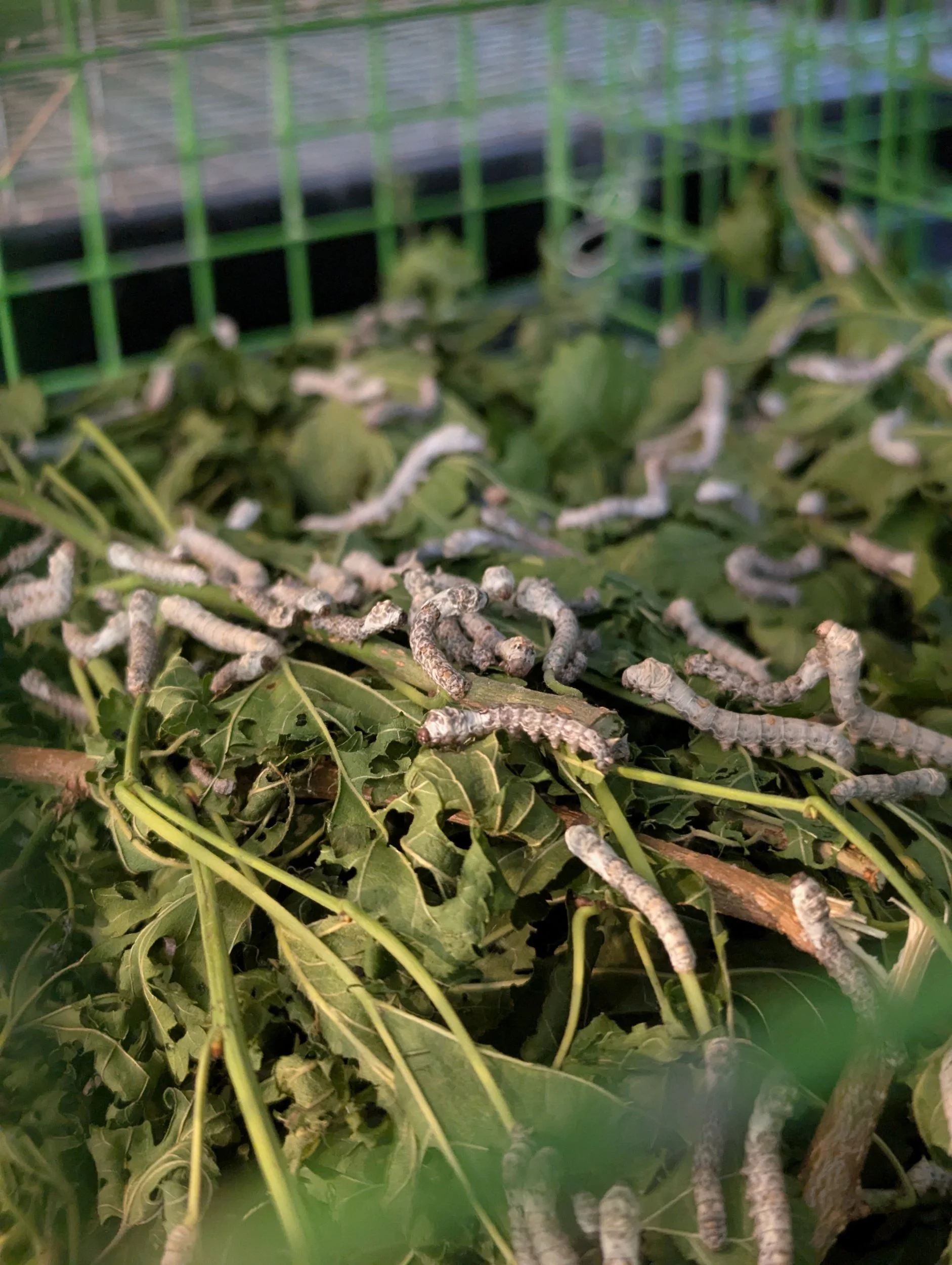
How do you travel 4,000 miles with a silk worm?
They hear me, they look for leaves to drop.
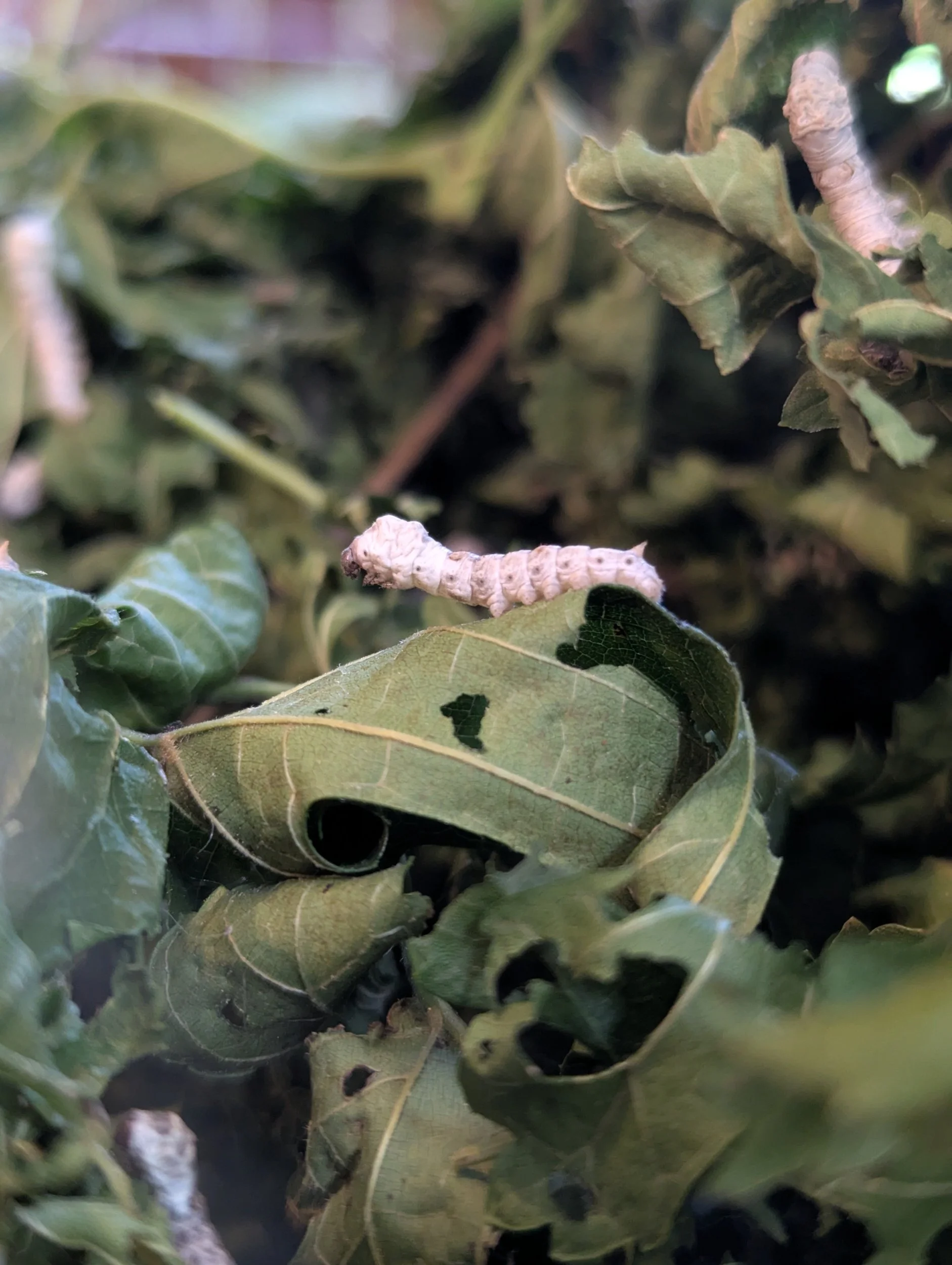
14 day old silk worm
Two accounts in antiquity describe in short detail how silk worms were smuggled from the people of Seres, the home of the silk worms. The making of the silk, animal included, had been a coveted secret of the people for an impressive span of time, that we know. I feel the need to be careful in this description of location, Seres is the home to those in antiquity that lived in China along the Yellow River, South of the now Beijing. Before going into the two accounts from Procopius and two centuries later, Theophanes, regarding how the worms were stolen from the people of Seres, transported along the silk traders route, to be placed in the hands of Emperor Justinian in the core of the Byzantine Empire. Before that, lets review the life cycle of a silkworm, as it applies. The Seres political forces of the time were protective of their sericulture secrets, going to great lengths to protect the knowledge of silk production. But, the worms also had safe guards built in to protecting them against being stolen away from the Yellow River. I think the worms protected themselves better than human attempts, if frailty can be considered a virtue. I have put great consideration into how to keep worms alive in travel, its a terrible experience for a worm farmer. 10 out of 10 stressful for silk worms and farmer, like taking a cat to a vet on steroids.
The worms’ life cycle is short, the cocooning cycle is even shorter, the moth phase less than the first two phases. Egg phase can undergo diapause dormancy, also known as over winters, 40 days as a worm, 14 days in the cocoon, and 10 days as a moth. Traveling the silk road took at minimum a year between the Byzantine Empire and the Yellow River, and the path is not that of flowing with the richness of perfect weather and Mulberry trees. A dessert, dangerous mountains, and climate changes occur on the journey of the Silk Road. The trade route is famous for more reasons than just the trade, the trip was also an adventure.
Important question, which came first in evolution - the moth or the worm?
In the book, A World History of Silk by Aarathi Prasad, she spends a chapter flushing out the chicken or the egg question with a very interesting detail. Silk worms have perfectly invisible wings forming under their skin, the cocooning process sheds the skin over the wings, the hair follicles are formed in worm phase (worms are delightfully pet-able. They feel like the softest baby blanket, in worm form.) Cocooning reveals the beautiful moth that was always hidden in the body of the worm. The worms endure a short, very delicate, and fragile process in that shift from worm to moth. Stress occurring in the circular process of worm to moth leads to malformities in the animal during the phases of change, resulting in inabilities to reproduce. The worms are certainly unforgiving in their needs. Feed them or they die. Keep them at the perfect temperature or they die. Sun, dead. Ants, dead. 20 degree temperature swing, dead.
Eggs can be kept cool for a few years to prevent hatching into worms. I’ve taken cooled eggs in my car, much to my surprise having hatched worms within hours, don’t get the eggs warm unless you’re ready to feed worms. The moth inside the cocoon is hot and cool temperature sensitive to the extreme of sensitivities. I do not move the cocoons that I wish to hatch into moths for breeding cycles. Side note, I buy all my silk worm eggs off Amazon, have them shipped via USPS and in seven days, I have worms. Do it, order worms.
How do the antiquity historians of past tell the tale of stealing the worms from the Country of Seres? Its theft. Lets call it what it is, smuggling is soft lingo used to lessen the offense. But the text say smuggled.
The second oldest account of the silk worm smuggling comes from Theophanes, 9th century. He states in translation, (A 1729 translation of Theophanes worm documents was most recent translation of Theophanes that I could summon online or in book form. I found the translation shorts of a doctoral student to be just fine for this purpose). So, he states that a Persian snuck the worms out of the country of Seres in his walking stick. He feed them the leaves of the Mulberry as they cycled all his journey. And it was love at first sight when he revealed the worms to Emperor Justinian, and also the Turks. Who wouldn’t like a surprise like silk worms. Happily ever after xoxo.
If only it was that easy. Just feed them leaves. So casual after a 4,000 mile trip. #CakeorDeath #Deathplease #No!Cake!
The oldest account of the story of how worms crossed the silk road comes from Porcopius. This guy was absolutely fascinating, worth the short wiki-walk linked above. He was the advisor to Justinian, the Emperor mentioned above in the 2nd oldest story. Porcopius, in theory was in the house when the worms arrived. He should know how it went down. At least, that is how I am understanding this timeline in piecing it together. Porcopius wrote that two Indian Monks arrived with the smuggled worms. To keep them alive on the trip, the Monks covered the worms when hatched with dung for warmth and that provided the cycle of egg, worm, and moth.
Not once have I thought to myself, I should cover my worms in poop. I’m still in reflection, I would think the worms kept near the human body would be better. Like the Queen of the Indies who smuggled cocoons in her wedding cap centuries later. Again, the goal is 78*F or frozen for eggs.
Time for a map. The cocoons, worms, moths in cycle traveled the whole road from the very right side of the map to the very left and beyond.
I’m not captain obvious in saying the tale given in historical accounts is not what happened. A witness writing the tablets or not. Bless carbon dating technology, bless it. Lets all say this together, “WE BELIEVE IN SCIENCE”
It has become cliche for historians to make dateable claims in this modern day, what I say today in dates will be wrong tomorrow after the lab results return for yet another artifact. It is all still a jumble, but the data is starting to give shape to the slow crawl of the worms across the continent. Much like the spread of the invasive Mulberry trees, the worms go where the trees go. Not naturally, human controlled movement of the worms. And in this instance, the humans involved gave raving support to the progress of Mulberry tree expansion with bird assistance in magnitude, therefor increasing the spread from many aspects. And that focus on tree spread deserves fresh research insights. I wonder how arborist historians feel about Mulberry history?
Todays blog post is brought to you by these readings that I have found on the subject of the stolen cocoons gifted to Justinian.
The translations provided by Feltham were excellent, given the circumstances of lack therefo in available resources: Feltham, Healeanor. Justinian and the International Silk Trade. Sino-Platonic Papers. 194. Nov 2009. Link to text
Shout out again to A World History of Silk by Aarathi Prasad. I own book and audio book, both are great. I think she is also obccessed with this story.
I didn’t use any of Anne Muthesius’s works in this blog post, but she is coming up next!
and for my worms, today is day 14 and its cool with a high of 74 so they are not eating as well as they should. I kinda want to put a space heater on them for a few hours.