A Silk Coif for a Baroness
It is a slow rainy day on the farm. The worms being little are easy to care, now is a good time to share the story about how I created a coif for a dear friend.
A Silk Coif for a Baroness
By farmer and fiber artist Lady Philippi of the Barony of Flaming Gryphon
In early February, the incoming Baroness of Flaming Gryphon, Mistress Thyra Bubbasdottir, requested the weaving of custom trim to decorate a recreation Coppergate Silk Cap to be worn at her Investiture in early April. Found in the 16-22 Coppergate dig site, the cap and trim recreations are from two findings from the 10th century, and described in detail in the published journal collection of research in the book collective, Textiles, Cordage and Raw Fibre from 16-22 Coppergate; Anglo-Scandinavian Silks. [1]
Silk Cap
Prewoven silk textiles were used to make the head dress, provided by Mistress Thrya. The cap measurements are formed to the Mistress’s head and design is found in the above mentioned book in the chapter on Anglo-Scandinavian Silks. [360, 1]. Several caps were made in an attempt to find the right fabric for the task. Problems encountered included the frayings of the silk filaments, warp not holding shape after adding layers of structure, and making the curve of the cap to shape of head. The coif is still in progress as the documentation must be finalized, this was not the focus of the project but rather the framing for the art.
Tablet Woven Trim
The trim pattern consists of three separate patterns combined with some edits and contributions from the maker. The edge has two elements combined, the Coppergate finds from the dated 912ce time period included a silk trim band with a zigzag pattern in “two red, six natural, six brown, eighteen red, eight natural, four brown”[1] silk and wool threads as it is listed as the found, amended in this new pattern to Baronial colors of black, yellow, and natural white. When dyed with lichens, the black is a silvery grey and the yellow comes out as a royal gold. Several recreations, rather interpretations, of the trim from the dig site exist, having a zig zag pattern in the weft lines of the trim. The original has the white zig zag popping out in the pattern with a red background and natural edges. The new interpretation is black edging with white and gold zigzag patterning, with the gold as the zig and zag.
The second part of the trim is the ermines, which is considered a modern addition to the project, not dated to the Coppergate dig site. Several patterns were sourced and a twenty tablet pick up stick version was incorporated into the pattern. [2]
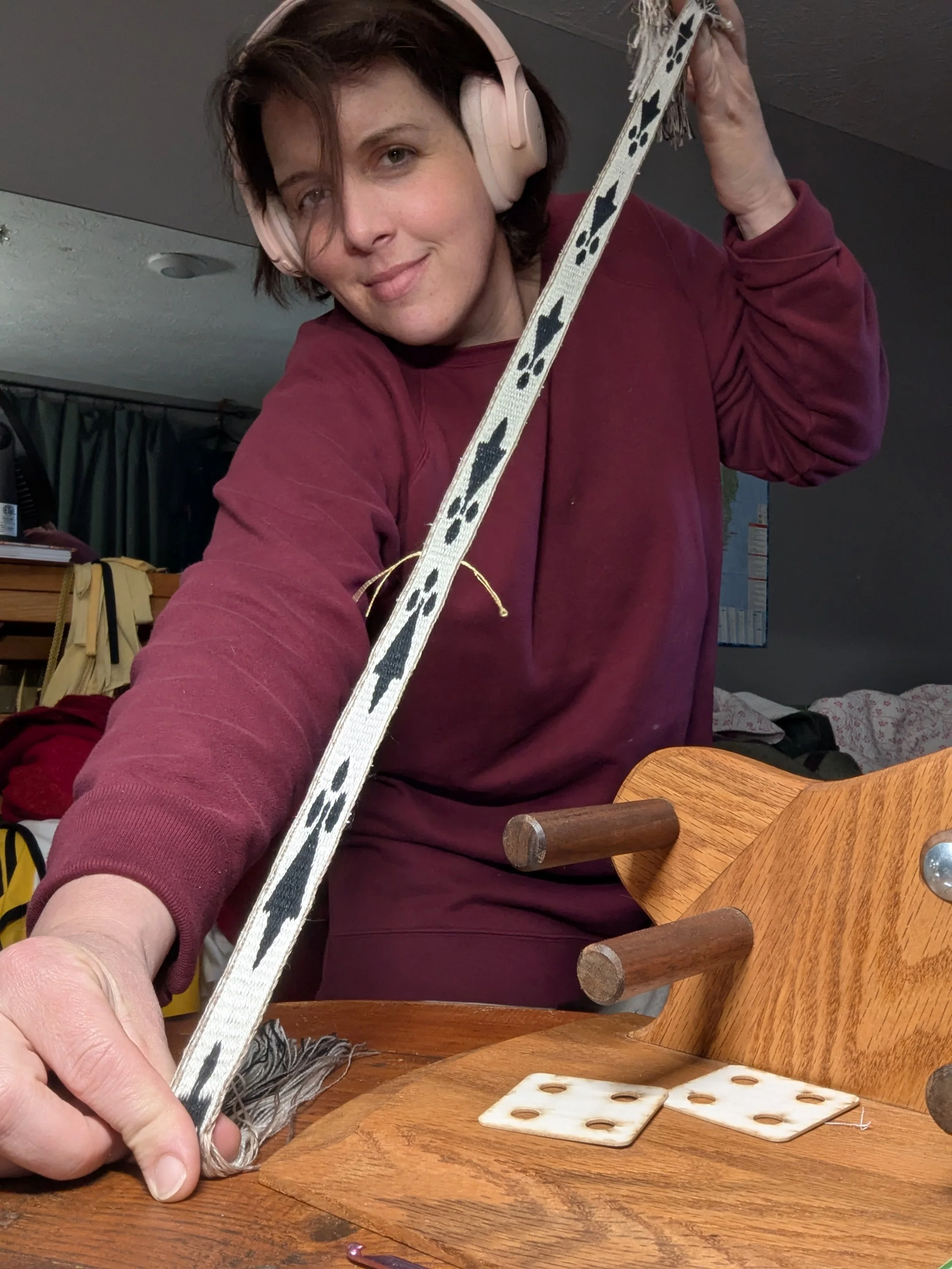
The pattern was tried in three formats, Angora fiber blend yarn, purchased pre dyed/set cotton from TippCity Weavers, and the final project was woven in silk handraised and reeled in the full process in the Barony of Flaming Gryphon. In reality, the whole project, on three looms, was born and raised in the Barony. Even the rabbits are generational to the Barony, the marigold seeds were from a Thursday seed swap at a fighter practice. What love we put into our Barony, we are given back ten fold as the seeds become the yarn, then woven into the highest adornment gifted to our own. I digress.
For the Angora yarn, it was hand and mill spun blends of BFL wool from a local friend, and premium breeder of the majestic breed of sheep, and Angora from Philippi’s personal show rabbits. The yellow was dyed with marigolds and the black/grey is natural black giant Angora. Twelve feet of trim was warped onto the floor Louett tablet loom with 38 tablets, including the Coppergate pattern and the twenty tablets for the ermines running the center line of the trim.
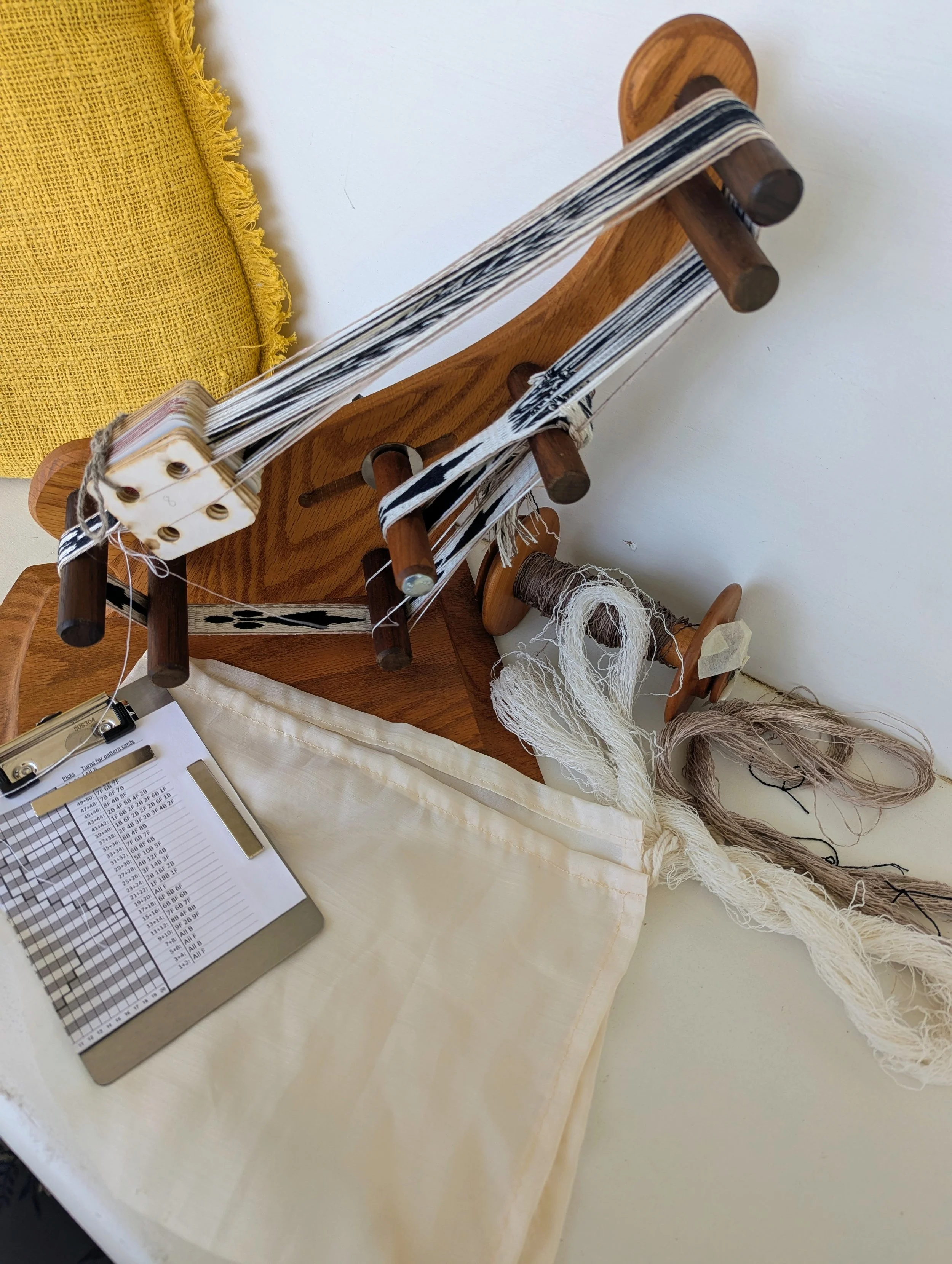
The silk was part of the 2025 batch of worms hand raised by Philippi at her farm in Lebanon, Ohio. The silk cocoons were reeled at Pennsic in pots of 100. The singles were given a twist of 8 to 12 twist per inch, then plied together into two ply with a twist of 28 to 32 twist per inch. The silk was dyed with lichens using heat and tincture soak timing to create various colors of gold and a blackish-grey. We shall never forget Carlos! From the Tale of Carlos the Golden, the guy who peed in a jug at Pennsic that dyed the silk used in this project and many other tablet trims! The silk was degummed as it was being prepped to be dyed, see Philippi’s 2024 War Point entry for the details into the use of Lichens for purple dyes in Roman period.[3]. The pattern was drawn out several times in an attempt to balance the tablet pattern against the two styles of weaving used in combining the two patterns. The end pattern has 58 lines of weft in variations of pickup with 14 warped tablets that are not twist neutral.
The silk was warped onto a loom created by a Knight and Laurel of the Midrealm, known to the weaver through his partner, Mistress Isabeau, what a glorious little loom made with hands of love and skill. The experience of weaving the trim was pure delight, made perfect with loom and thread, and will always be a treasured experience by the maker.
To those who inspire me, who stick by me through thick and thin, and call me friend, with my deepest love, thank you for being in my life.
[1] Walton, Penelope. Textiles, Cordage and Raw Fibre from 16-22 Coppergate. The Archeology of York. The Small Finds. Volume 17, Issue 5.
Council for British Archaeology for York Archaeological Trust. 1989. 9780906780794
https://www.collections.yorkarchaeologicaltrust.co.uk/s/collections/item/74494#lg=1&slide=0. Book Link.
[2] Stringcrafter. Tablet Weaving 4 Hole Projects, Ermine 2. https://stringcrafter.com/wp-content/uploads/2019/08/tw4-20c-doubleface-ermine2-along-band.pdf
[3]Greenwood, C. Poor Man’s Purple: Experiments and Research into the Origins of Purple Pigments from that of Lichens. 2024. https://catherineagreenwood.net/scaphilippi